
The Anatomy of an Empath
The Anatomy of an Empath explores the deep connection between humans, nature and all living beings. Timothy Kamuzu Phiri reflects on how empathy is shaped through upbringing, life experiences and moments of awakening, reminding us that compassion for all life is something we must nurture and pass on to the next generation.



An Owl in Daylight
The eerie hoo-hoo of an owl is one of the typical sounds of the night. But some owls are also active during the day. Like the Barred Owlet, which is found in the north-east of South Africa.

A Day out of the Kruger Park
Kruger National Park in South Africa is one of the most beautiful places on our planet. Numerous tourists travel from other regions, other countries, even other continents to spend just a few days there. But many of the local people who live only a few kilometres from the nearest entrance have never been there. Why is that?

A Day in the Kruger Park
It is the largest protected wildlife area in South Africa. It was established on 26 March 1898, at that time much smaller and under the name Sabie Game Reserve. Today, the Kruger National Park attracts 1.3 million visitors each year – for good reason.

The Scent of Rain and Life
The smell of rain on dry earth hangs in the air. A light breeze provides cooling. The rainy season completely changes the appearance of the savannah: the sparse landscape of yellowish-golden grass and bare trees has become a dense jungle teeming with life. Toto was right: I bless the rains down in Africa!

A Cry Making the Blood Run Cold
Over 150 years ago, millions of elephants roamed most of the African continent, as well as in Asia from China in the east to Iraq in the west. But due to hunting, poaching and habitat loss, both Asian and African elephants are now only found in highly fragmented habitats. In Southeast Asia, many elephants are used as domestic and working animals. But as for the wild, free-ranging giants, they are endangered. There are two different groups of elephants that live in Africa; the forest elephant (critically endangered) and the savannah elephant (endangered).After excessive trophy hunting in colonised Africa at the beginning of the 20th century, only a few populations of the savannah elephant were able to recover. Due to ongoing poaching, populations continue to decline drastically. About 20,000 elephants are killed in Africa every year.

A Cry, Red in Tooth and Claw
Jaguars have already lost about half of their natural habitat in the tropical rainforest of Central and Southern America. In addition, they are frequently shot by farmers, miners and loggers who want to protect their livestock or themselves. So it is not surprising that jaguars are classified as near threatened. This may soon worsen, however, because there is a new threat to the wild felines: the illegal trade in jaguars and their body parts, driven in particular by China.

A Cry Making The Feathers Fly
This parrot is up to 90 cm tall, lives in Central and South America and has a beautiful green and blue plumage. And it is because of this beautiful plumage that Great Green Macaws are hunted or illegally traded as pets. Their greatest threat, however, is the loss of their habitat: This macaw is associated with the mountain almond tree, an endangered plant that is nevertheless being cut down. There are now only about 500 to 1000 Great Green Macaws left in the wild.
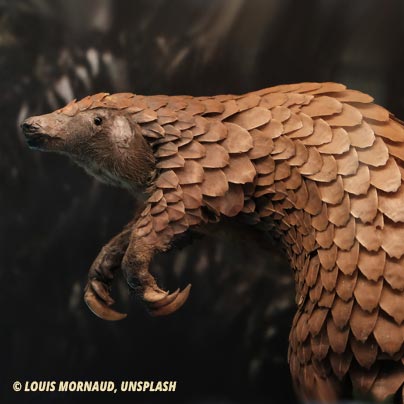
A Cry Scaling Off Soon
It looks like a pinecone, a walking pinecone with a tongue longer than its own body. This fascinating mammal is called a Pangolin, an animal fairly unknown to most people in the world – even though it’s the most trafficked animal in the world! In some Asian countries, their meat is considered a delicacy in noble restaurants. Their scales and claws, on the other hand, are used in traditional Chinese medicine. There are a total of eight species in the world, living in Asia and Africa. And all eight species are threatened with extinction.

A Cry Bone-Deep
Lions once roamed large parts of Africa and Southwest Asia. Today they are found only in scattered regions in the grass and scrublands of Africa. Their populations are declining, partly due to the high demand for lion bone and teeth to be used for Traditional Chinese Medicine. In Mozambique, for example, poachers use poisoned bait to kill the lions and then cut off their heads and paws. In South Africa the dubious industry of lion breeding is involved in the trade of bones of these majestic cats.

Stay in the know.
Be ready to act.
To keep up to date with our latest news, events, marches,
campaigns and fundraising activities.