
Mambas in the Park: Foundation of Life – Koru Camp, September 2026
What can a rock, a magnet, a chameleon and a pride of lions teach us about life? Quite a lot! This September, the Mambas explored geology, weather and climate through hands-on learning and unforgettable moments in the Greater Kruger, discovering just how deeply connected everything in nature really is.
By Valeria van der Westhuizen
Foundation of Life
Who would think that the rocks we see beneath our feet every day are the foundation of all life?
Our September camp laid the foundation for understanding life on Earth. Following the FGASA training manual, we focused on two essential topics: Geology and Weather and Climate.
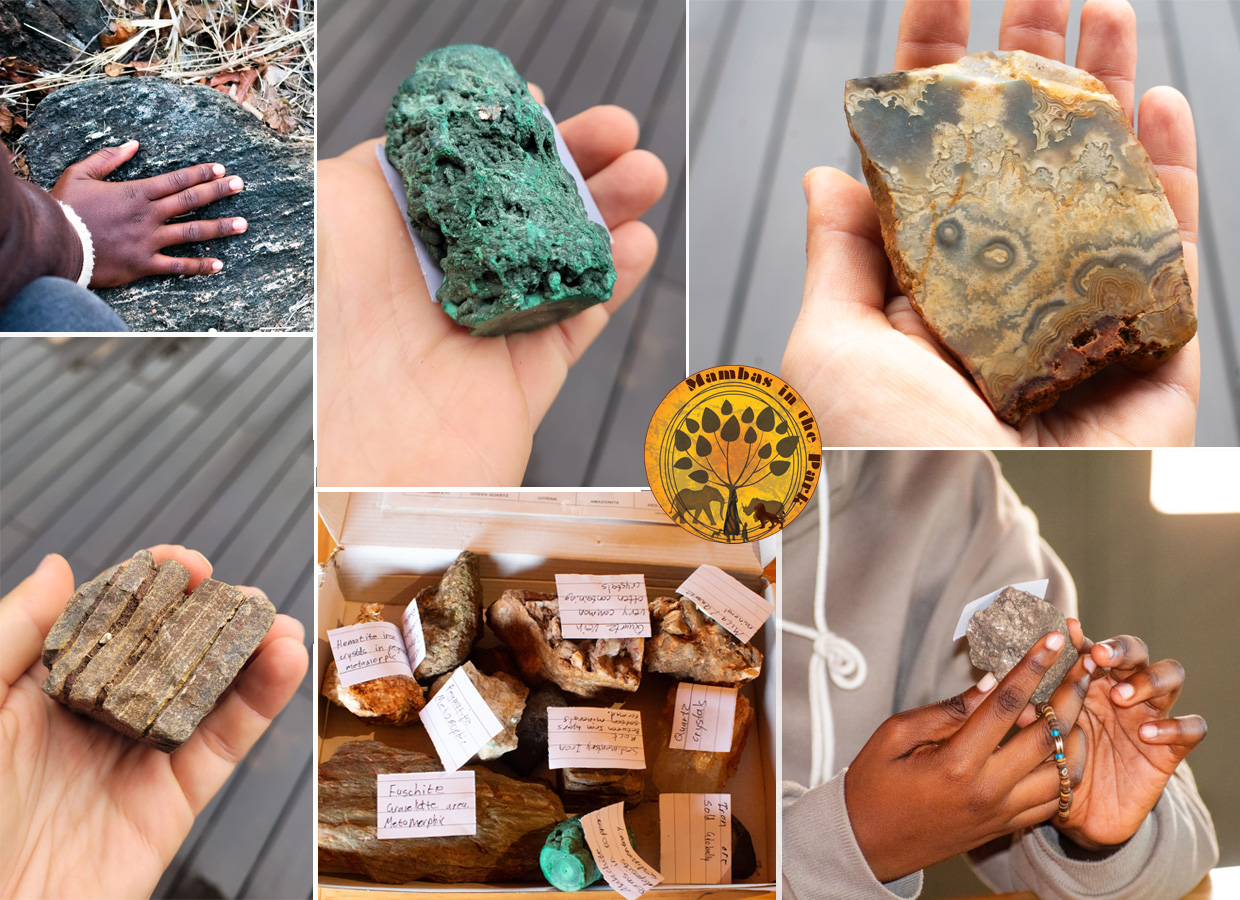
Something came to our minds this time: what if we complemented our workshops with real-life objects? Our facilitator, Valeria, brought along a fantastic collection of rocks and minerals from around the world. She had borrowed them from her colleague at Transfrontier Africa, Kyle van Rooyen, to demonstrate that although Earth is one interconnected system, different geographical areas can have very different geology.
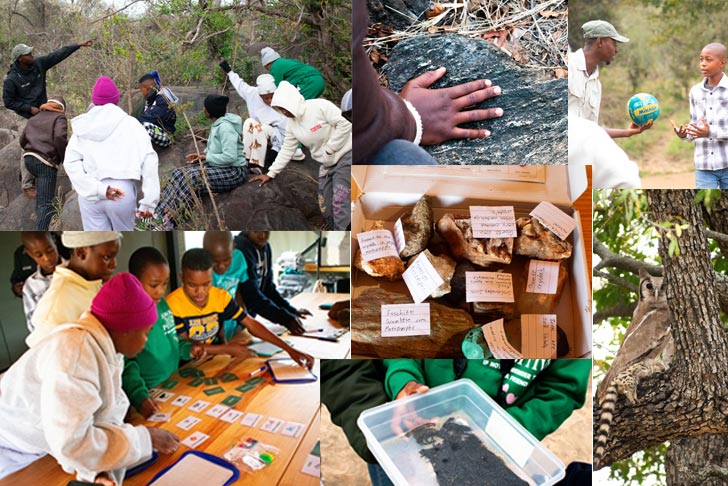
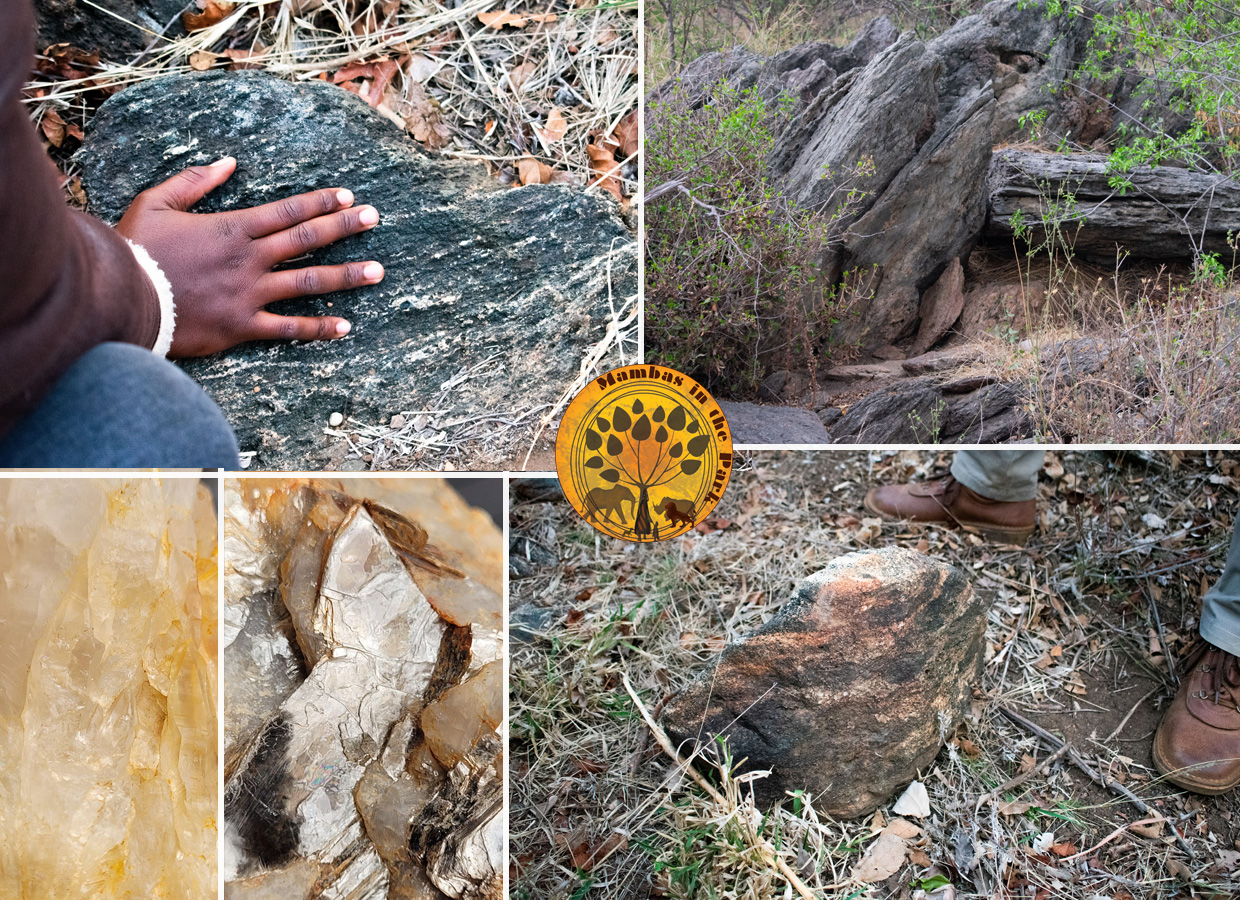
During the workshop, we discovered that the Greater Kruger is underlain by two major rock types — granite and basalt. We learnt the differences between igneous, sedimentary and metamorphic rocks, and had a close look at examples from the collection as well as rocks we encountered during our game drives.
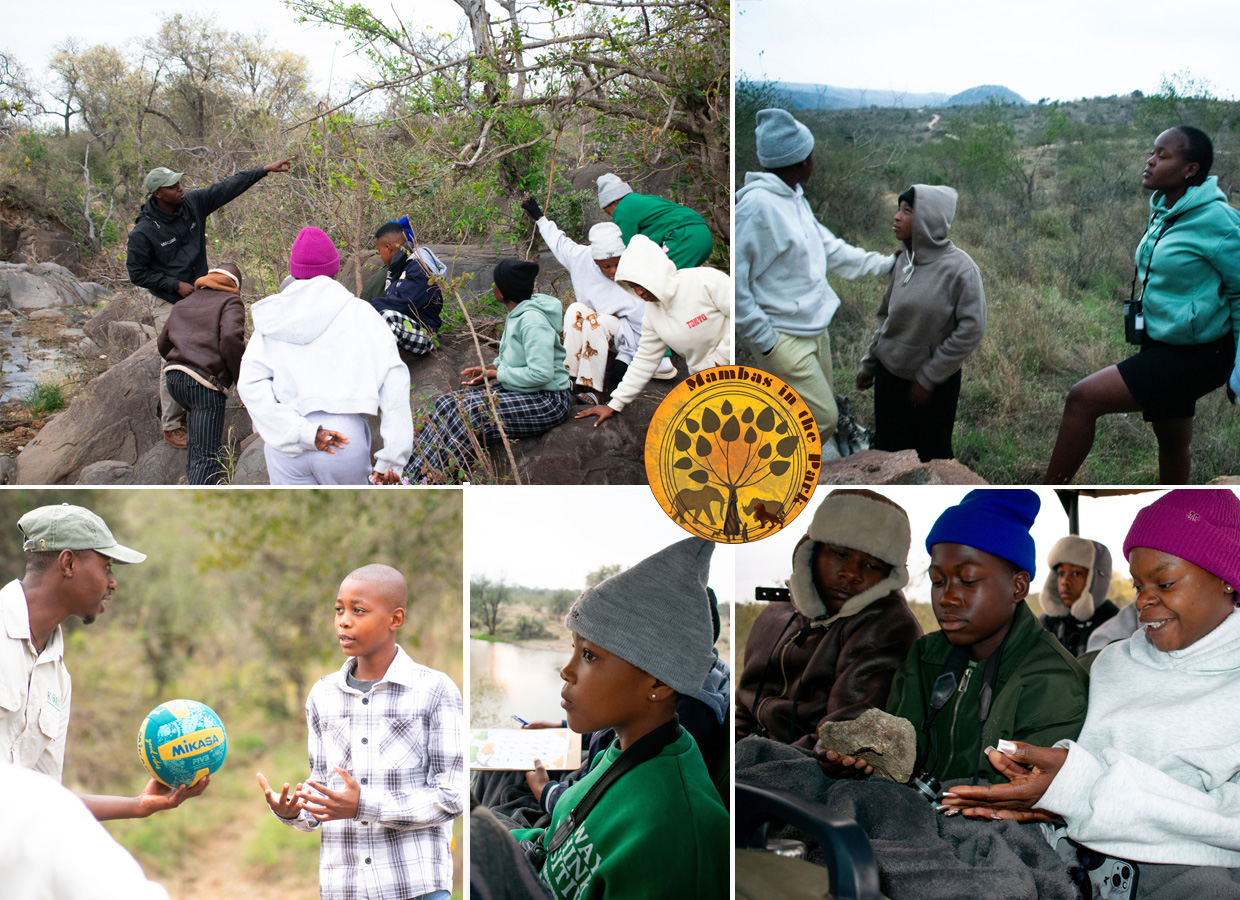
Luckily, rocks are abundant in Jejane Reserve, and our knowledgeable guide, Koki, selected some of the best examples for us to explore.
The children were encouraged to look at the rocks closely, feel their shapes and textures, observe their colours, and identify the different minerals that make them up. Everyone loved the shiny mica!
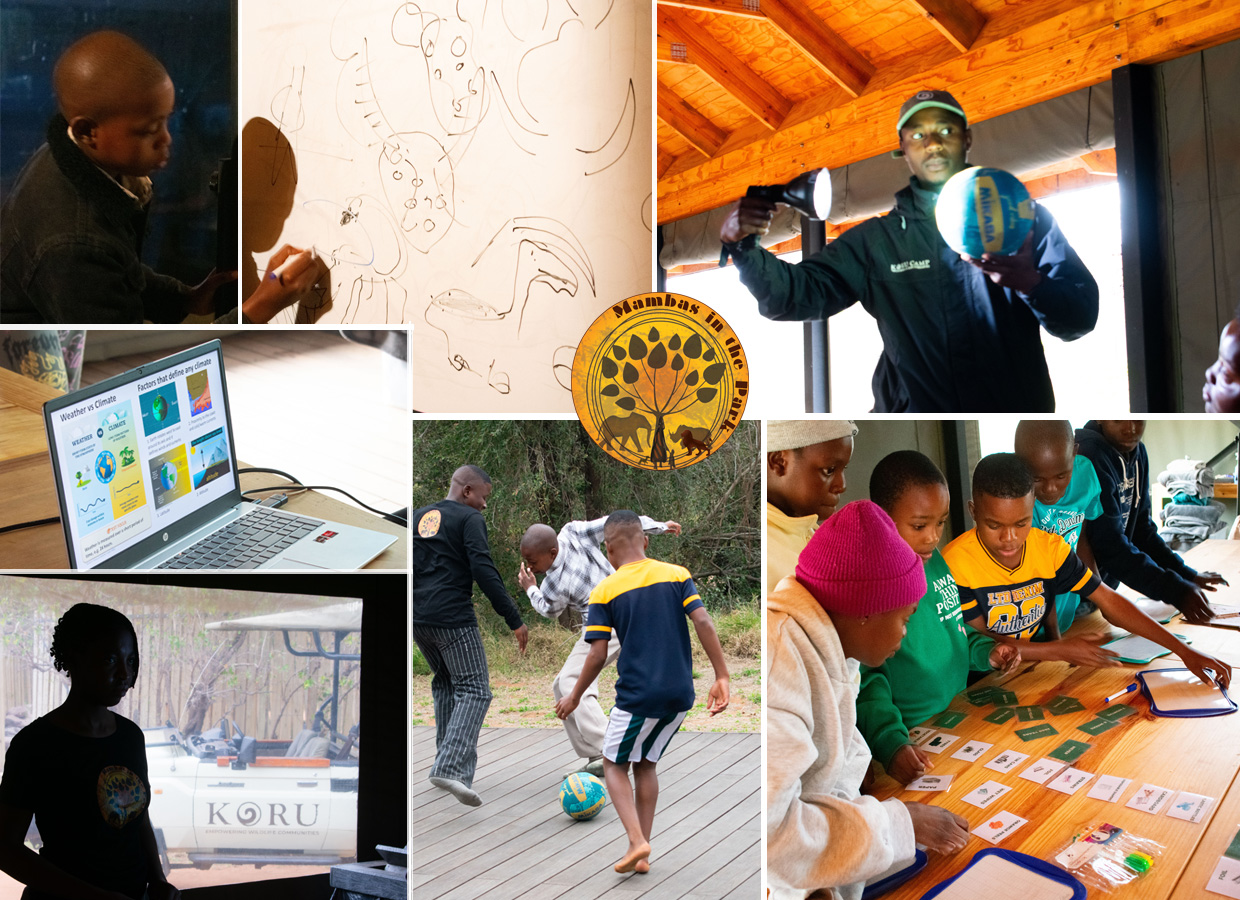
While Acacia and Lunghisani were seated writing their trial Geology test, the younger children enjoyed drawing rocks from the collection we had brought and classifying them based on the labels and descriptions provided. Check out some of their awesome drawings in our gallery!
Our geology game drives were highly experiential. We drove across different rock formations, saw granite and basalt, and found a very good example of a metamorphic rock called gneiss. It was fascinating to learn that metamorphic rocks can form when existing igneous or sedimentary rocks are transformed by intense heat and pressure deep within the Earth. Temperatures involved in metamorphism can range from around 300°C to 600°C and beyond, depending on the conditions.
What a surprise it was to see Koki take a magnet and some toothbrushes out of his bag and look at us mysteriously! The next thing he did was take the magnet and draw a spiral through the river sand.
What could that be, and why was he doing it?
With a big smile on his face, Koki showed us that the magnet could collect tiny particles of the dark-coloured sand — and it really did! The dark, almost bluish-black grains were attracted to the magnet, quickly forming a fluffy coating around it.
We learnt that these dark particles are magnetite, a mineral with strong magnetic properties. We tried it ourselves and had great fun experimenting with the sand. We used toothbrushes to clean the magnetite from the magnets and collected it in a container. Did you know that if you place the magnet underneath the container, you can actually see the magnetite particles moving inside?
“Koki made sure the learners learnt and also interacted. We learnt from the books, later on game drives, and we experienced everything we learned by touching and feeling. In our Geology adventure, we interacted with all the types of rocks. Believe me, I have started my own rock collection because of the lessons! It was so refreshing and mind-blowing! I so wish I had that exposure when I was a child,” reflects Black Mamba facilitator Naledi Malungane.
Lunghisani and Acacia had their very first experience learning and then teaching FGASA material on Geology.
“Before we studied geology, I thought the rocks were all the same and the only difference was the colour. Now I understand that they are different and classified into types. It was amazing to hear that rocks determine the types of soil, which in turn influence the plants and then the animals. It is because of rocks that certain plants and certain animals are found where they are on the planet,” says Acacia.
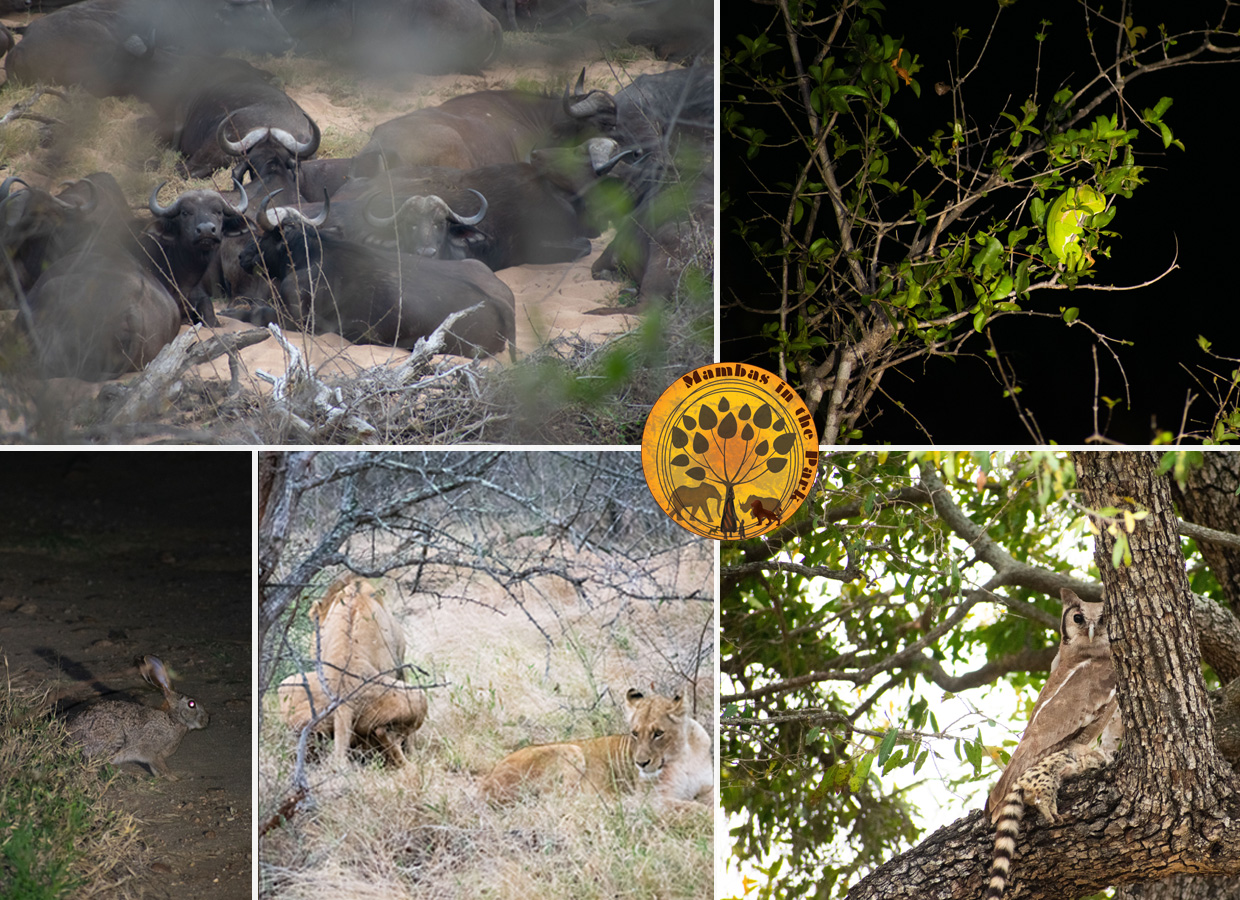
In between workshops, we enjoyed game drives. The weather was not particularly favourable for seeing many animals. The sky was grey, it started drizzling, and at times the bush seemed a little empty. However, we still managed to see a herd of elephants, a huge crocodile and many hippos in the Olifants River.
One of the smaller, but perhaps most memorable, sightings of the camp was a flap-necked chameleon sitting quietly on a small tree. It was completely green, blending almost perfectly with the leaves around it. We would probably never have noticed it if Koki had not been using a spotlight. During our night drives, we use the spotlight responsibly, taking care not to shine it directly into animals’ eyes and keeping disturbance to a minimum. In this case, however, the chameleon was so small and well camouflaged that the light allowed us to see it properly and appreciate just how perfectly it had disappeared into its surroundings.
Chameleons are remarkable animals, not only because of their ability to camouflage themselves, but also because of their unusual independently moving eyes and their ability to adapt to their environment. In some South African traditional belief systems, including beliefs associated with sangomas (traditional healers), the chameleon is regarded as a symbol of deep wisdom. It is sometimes seen as an example of how people can remain calm, observe their surroundings carefully, adapt to changing circumstances and, through its independently moving eyes, symbolically see both what is behind and what lies ahead. Perhaps our little green chameleon had its own lesson for us: sometimes you need to slow down, look carefully and change your perspective to see what has been there all along.
This time, we also had a guest, Bruce, a volunteer from the USA who was travelling across South Africa and participating in various conservation projects. As it happened, he met Rosemary quite unexpectedly just before the camp and became curious about the work of GMFER. His biggest wish was also to see lions, as he had never seen them up close before — and this was his first time in South Africa.
The trip definitely did not disappoint Bruce. On the second day, we saw five lions relaxing together, and a male and female even mated right in front of us!
Another topic we explored was Climate and Weather.
Now we know the difference between weather and climate. And now we know that climate also contributes to the types of plants and animals we have in South Africa,” notes Lunghisani.
We watched a very good short documentary about the important role trees play in regulating the climate. In December we are going to do something exciting for the topic of Plants and Trees, so stay tuned!
Following the discussion and the film, Koki and us played a superbly useful and educational game. We had to identify how long different materials take to decompose once they are discarded. Some of the answers were not easy to remember, although we got many of them right.
The mind-blowing discovery came at the very end of the game: there is a household material that does not ever decompose. Guess what it is?
Foil.
We will never look at foil in quite the same way again!
“At the end of the camp, the kids were asked what each of them can do to tackle climate change, and we got very good answers, such as planting trees, not wasting food, closing taps, switching off lights, and reusing plastic containers and bags wherever possible,” recalls our facilitator, Valeria.
These may seem like small actions, but they reflect a much bigger understanding. The Earth is a connected system, and the things we do every day can have consequences far beyond what we can immediately see.
Geology teaches us to look deep into the past. Rocks record an Earth that has been changing for billions of years, while weather and climate help us understand the conditions that shape life on its surface. By learning how rocks, soils, water, atmosphere, plants and animals are connected, we begin to see that there is no single “environment” separate from us — we are part of the same system.
Perhaps that is one of the most important lessons we can give the next generation: understanding the Earth is the first step towards caring for it.
 |
 |
 |
 |
 |
Mambas in the Park is GMFER initiative with partnership and support from Transfrontier Africa.
Our thanks to KORU Camp and its dedicated guides and staff for amplifying our work.
Every problem has a solution, every solution needs support.
The problems we face are urgent, complicated, and resistant to change. Real solutions demand creativity, hard work, and involvement from people like you.

Stay in the know.
Be ready to act.
To keep up to date with our latest news, events, marches,
campaigns and fundraising activities.